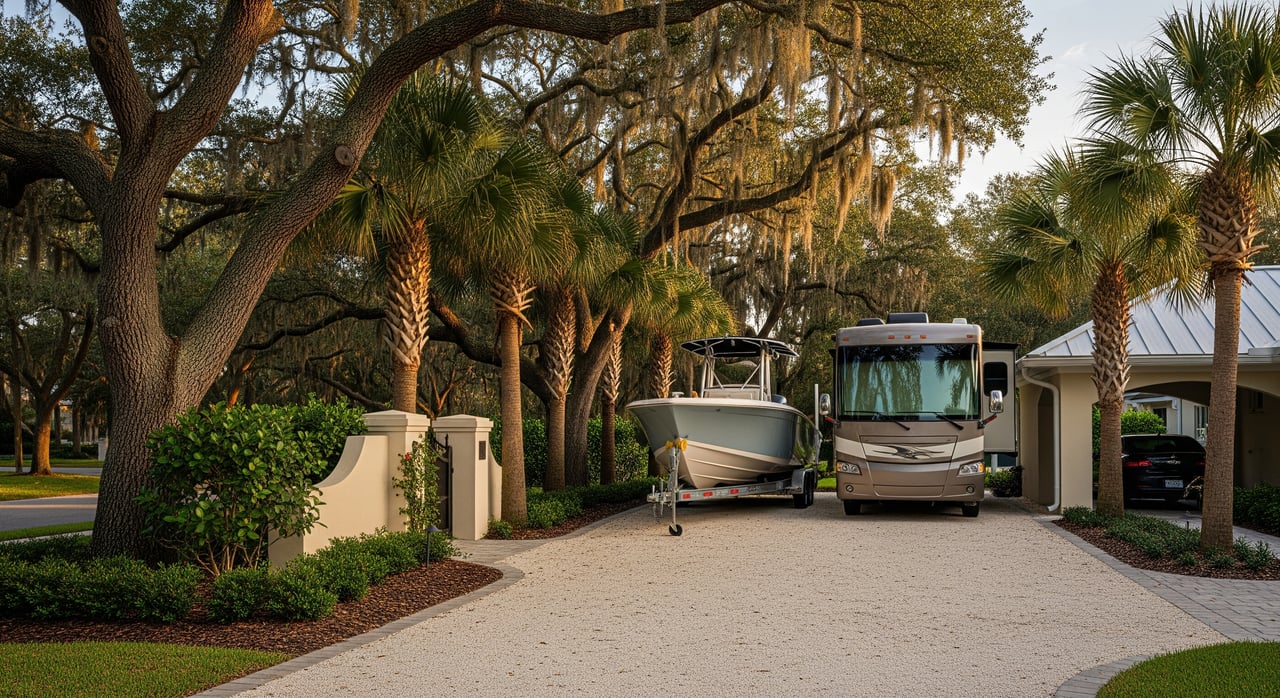
Thinking about bringing your boat or RV to Sugarmill Woods? Before you park it in the driveway or along the street, it pays to know how rules work here. Many homes sit within deed‑restricted neighborhoods where associations and committees oversee appearance and parking. A little planning saves you from fines, towing, or a neighbor complaint.
In this guide, you’ll learn how Sugarmill Woods rules are set, what temporary parking is typically allowed, how Citrus County enforcement fits in, and the exact steps to request approval. You’ll also get practical tips to avoid issues. Let’s dive in.
Know the rulebook layers
Sugarmill Woods is a large, deed‑restricted community in the Homosassa area of Citrus County. Parking and storage rules are usually set by recorded covenants, conditions and restrictions, often called CC&Rs. These are enforced by homeowners’ or property owners’ associations and by architectural review or compliance committees.
You should check for rules at multiple levels:
- The recorded CC&Rs for your specific neighborhood or subdivision. These are the primary legal source for parking and storage.
- Any communitywide POA or umbrella association rules that may apply to your lot.
- Architectural Review Committee (ARC) guidelines and prior decisions that clarify what is allowed.
- The management company or POA staff, who implement and enforce rules day to day.
- Citrus County ordinances for public roads, right‑of‑ways, and public safety.
Authoritative documents are found in public land records with the Citrus County Clerk and through your neighborhood’s HOA or POA office. If you cannot find your CC&Rs through the association, you can request recorded documents from the Clerk. For public‑road or safety questions, Citrus County Code Enforcement and Planning and Zoning are the right contacts.
What is typically allowed
Rules vary by neighborhood in Sugarmill Woods, so always verify your lot’s CC&Rs and current HOA guidelines. Still, most owners see similar patterns across Florida deed‑restricted communities. Here is what is commonly allowed for temporary boat and RV parking:
- Short‑term parking on your private driveway. Often allowed for a limited time. Duration limits vary and may require advance notice or approval.
- Street parking with restrictions. Many associations limit or prohibit boats and RVs on community streets or set strict time windows. County rules also apply on public roads.
- Temporary permits for guests or projects. Associations sometimes issue time‑limited permits for visiting family, repairs, loading, or seasonal use. Dates and specifications usually must be provided.
- Long‑term storage rules. Outdoor, long‑term storage of boats, RVs, and trailers is often prohibited unless fully screened, placed in a specific location on the lot, or stored offsite. Some neighborhoods require offsite storage.
Common limits to expect
Even when temporary parking is allowed, you will likely see conditions. Plan for the following types of limits:
- Time limits. Temporary windows can range from a few days to a few weeks with prior approval. Exact durations are set in CC&Rs or by board policy.
- Location rules. Many neighborhoods restrict parking to your driveway or garage and prohibit blocking sidewalks or the public right‑of‑way. Rear‑yard placement with screening is sometimes allowed by approval.
- Appearance and condition. Vehicles usually must be in good repair, properly registered, and free of visible deterioration. Covers may be required.
- No commercial use. Using an RV or trailer as a base for business activity is commonly prohibited.
- No hookups. Active water, sewer, or electrical hookups to an RV are often prohibited without permits. Associations and county rules may both apply.
- Size and configuration. Length, height, or hitch limits may apply so vehicles do not obstruct neighbors or emergency access.
- Permits and fees. Some associations require a written request, proof of registration or insurance, and a processing fee. A permit placard may need to be displayed.
These limits support aesthetics, property values, safety, emergency access, and maintenance of roadways and drainage.
HOA rules vs county enforcement
Associations in Florida enforce private covenants through procedures set by their governing documents and state law. They can adopt rules, require approvals, and issue violation notices. Many enforcement steps require notice and an opportunity to be heard. Keep your approvals and communications in writing.
Citrus County Code Enforcement handles county ordinances tied to public safety, right‑of‑way issues, and certain types of outdoor storage. If a vehicle blocks the public right‑of‑way, creates a hazard, or violates a county rule, the county can act even if the HOA is not involved. Traffic and registration issues may involve the sheriff or traffic enforcement.
When county code and HOA rules overlap, both can apply. If county code allows something but your recorded covenants prohibit it, the private covenant is still enforceable by the association. The safest route is to obtain written HOA approval and follow county rules at the same time.
Step‑by‑step to stay compliant
Use this simple sequence to keep your parking plans on track.
- Check your recorded CC&Rs. Look for sections titled “trailer,” “boat,” “recreational vehicle,” “storage,” “parking,” or “nuisance.”
- Get current neighborhood rules. Ask your HOA/POA or management office for any newer policies, resolutions, or ARC guidelines.
- Review county ordinances. If you plan to park on or near a public road, or for longer than a brief loading window, confirm county requirements.
Who to contact
- Your neighborhood HOA/POA office or management company.
- The Architectural Review Committee or compliance coordinator.
- Citrus County Code Enforcement for public‑right‑of‑way or county restrictions.
- The Citrus County Clerk or land records if you need copies of recorded CC&Rs.
What to include in your request
When a permit or written approval is required, submit a clear, complete request to the ARC or POA that includes:
- Dates and hours of the proposed temporary parking.
- The exact parking location on your lot or the street. Include a photo or quick sketch if helpful.
- Vehicle description: make, model, year, length, and trailer tag number.
- Reason for the temporary parking, such as a guest visit, repairs, moving, or seasonal use.
- Proof of registration and insurance if your association requires it.
Ask for a written decision and keep a copy with any conditions or expiration date. If a placard is required, display it as directed.
Plan your timeline
Response times vary by community and committee schedule. A 7 to 30 day window is a reasonable planning range. If you need quick approval, submit early and note any deadlines, like a delivery, repair date, or travel window. Keeping neighbors informed can reduce complaints during your approved period.
Enforcement and dispute options
Associations typically use progressive enforcement to correct issues:
- Courtesy notice or violation letter with a cure period.
- Fines for continuing violations, according to association rules and Florida procedures.
- Requirements to remove or relocate the vehicle.
- Towing or booting if allowed by association policy and state law, with posted signage.
- Suspension of community facility privileges in certain cases.
County enforcement can cite violations that impact public safety or the right‑of‑way and may order removal. In hazard situations, towing can occur through local authorities.
If a dispute arises:
- Request an internal hearing under your association’s enforcement procedures.
- Consider mediation if your documents provide for it. Many conflicts resolve through a structured conversation.
- As a last resort, owners can seek judicial relief, keeping in mind costs and timelines.
Keep a file with your application, written approval, and correspondence. Documentation is helpful if complaints or misunderstandings occur.
Practical tips that help
- Do not assume. Rules can vary by phase or even by street in Sugarmill Woods. Always verify your specific CC&Rs and current HOA rules.
- Get approvals in writing. A verbal OK is not enough if a violation letter arrives later.
- Plan ahead. Submit requests early for moves, repairs, or seasonal storage.
- Keep vehicles compliant. Registered, insured, and well‑maintained vehicles draw fewer complaints.
- Consider offsite storage for long periods. This is often the simplest path to compliance.
- Talk to neighbors. A brief heads‑up about a short, approved parking window can prevent a call to management.
- Ask targeted questions. Clarify time limits, placement rules, permits, fees, size restrictions, and any screening needs before you act.
Buying or selling in Sugarmill Woods
If you are evaluating a home in Sugarmill Woods and a boat or RV is part of your lifestyle, make CC&Rs and parking rules part of your due diligence. Ask for the recorded covenants, current HOA rules, and any ARC guidelines up front. Confirm what is allowed at that specific address before you make plans.
You deserve local guidance that balances lifestyle goals with compliance. As Your Florida Realtor with Engel & Völkers Ocala, Tamara Myers brings hands‑on neighborhood knowledge across Citrus and Marion counties and a service‑first approach that keeps your move smooth. Have questions about a property’s restrictions or how to structure your timeline? Let’s talk through your options and map out next steps. Get Your Instant Home Valuation today to start planning your move with clarity.
FAQs
How do parking rules work in Sugarmill Woods?
- Parking and storage are controlled by recorded CC&Rs for each neighborhood, any communitywide POA rules, ARC guidelines, and Citrus County ordinances for public roads. Always verify the documents for your specific lot.
Is short‑term driveway parking for an RV allowed in Sugarmill Woods?
- Many neighborhoods allow short‑term driveway parking with limits, and some require a temporary permit. The exact time window and conditions are set by your CC&Rs or HOA policies.
Can I park a boat or RV on the street in Sugarmill Woods?
- Associations often restrict or prohibit street parking for boats and RVs, and county rules also apply on public rights‑of‑way. Check both your HOA rules and Citrus County requirements.
What documents should I review before parking a boat or RV?
- Review your recorded CC&Rs, current HOA or POA rules, ARC guidelines, and Citrus County ordinances. If you need copies, contact your HOA office and the Citrus County Clerk.
How do I request approval for temporary RV or boat parking?
- Submit a written request to the ARC or POA with dates, location, vehicle details, reason for parking, and any required registration or insurance documents. Request a written approval and keep it on file.
What happens if I violate boat or RV parking rules in Sugarmill Woods?
- You may receive a violation notice, fines, or a requirement to move the vehicle. Towing is possible if allowed by policy. Public safety or right‑of‑way issues can also trigger county enforcement.
Do county rules override HOA parking restrictions in Sugarmill Woods?
- No. County ordinances govern public safety and rights‑of‑way, while HOA covenants govern private restrictions. Both can apply, and private covenants remain enforceable between the association and owners.